

Generative AI Implementation Playbook
Our Generative AI Implementation Playbook is a strategic, technical resource designed for engineering leaders, data architects, and C-suite executives to move beyond AI experimentation into production-grade delivery. It serves as an actionable framework for assessing infrastructure maturity, navigating the build-vs-buy landscape, and executing a risk-mitigated deployment roadmap.
Core Components
Readiness Assessment Matrix: A cross-functional audit tool to establish a baseline across data infrastructure, technical stack, and organizational talent. It identifies critical gaps in data sovereignty and GPU scalability before investment begins.
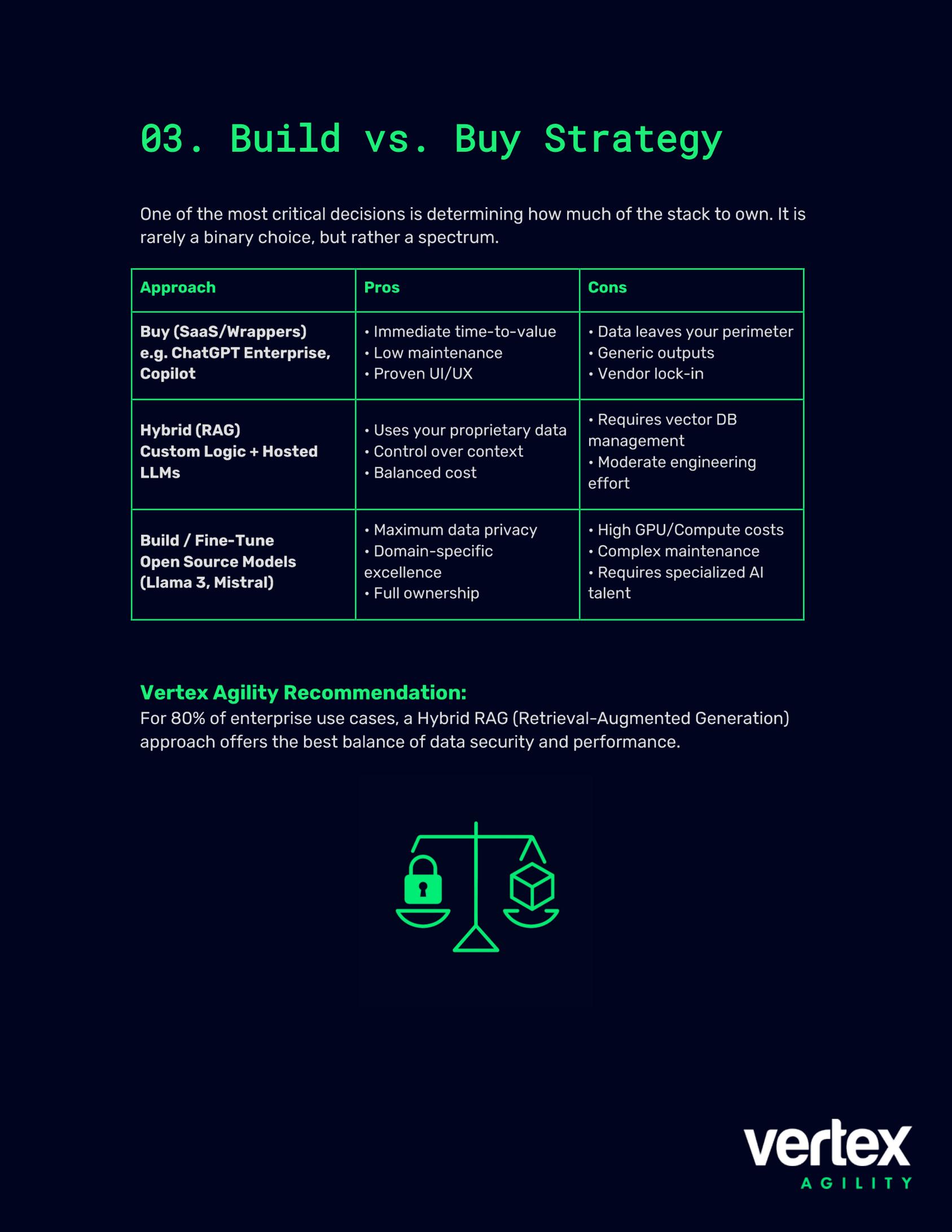
Strategic Build vs. Buy Framework: A comparative analysis of SaaS, RAG (Retrieval-Augmented Generation), and Fine-Tuning models, helping teams select the right architecture based on data privacy requirements and total cost of ownership (TCO).
Actionable Implementation Roadmap: A phased 90-day execution plan—from Proof of Value to scaled optimization—complete with specific milestones and technical guardrails.
Example page (click to expand)
Download our free Generative AI Implementation Playbook now
Further Information - Technical Coverage
The playbook provides detailed guidance on the following topics:
Foundational Readiness: Audit checklists for unstructured data accessibility, PII/PHI classification, and API-first data lineage to ensure model safety.
Architecture Selection: Deep dives into Hybrid RAG patterns as the enterprise standard for balancing real-time performance with internal data security.
The "Hallucination" Mitigation Strategy: Technical steps for implementing "Grounding" and "LLM-as-a-Judge" workflows to ensure output accuracy and automated fact-checking.
Cost & Latency Optimization: Proven methods for reducing OpEx, including semantic caching, model routing, and distillation to smaller, specialized models like Llama 3 or Claude Haiku.
Security & Guardrails: Establishing an "AI DMZ," preventing prompt injection attacks, and implementing NeMo or LangChain guardrails for toxic content filtering.
Operational LLM Ops: Guidance on monitoring model drift, establishing human-in-the-loop feedback mechanisms, and instrumenting "Golden Signals" for AI response saturation.
Mitigating Common Pitfalls: Detailed "How to Avoid" strategies for the most frequent causes of project failure, from scope creep to the "Magic Box" fallacy of model training.
Strategic Roadmap Execution: A phased 90-day sprint cycle designed to move from initial Proof of Value (PoV) to a production-hardened AI ecosystem.
Download our free Generative AI Implementation Playbook now

Our Partners


