

Cloud Migration Readiness Checklist
Our Cloud Migration Readiness Checklist is a cross-functional resource designed for engineering, operations, security, and data teams to assess readiness and plan a cloud migration. It functions as a practical guide for running workshops to identify risks and create executable migration plans.
Core Components
Readiness Scorecard: A tool to establish a shared baseline across delivery, security, and operations. It covers ten critical areas – including portfolio visibility, target architecture, and observability – to identify and address high-risk gaps before work begins.
Actionable Checklists: Ten structured sections that detail specific actions, required evidence, and assigned owners for every stage of the migration.
Practical Templates and Worksheets: Ready-to-use documents for immediate implementation, including a RACI matrix, wave planning sheets, a risk register, and a cutover runbook skeleton.
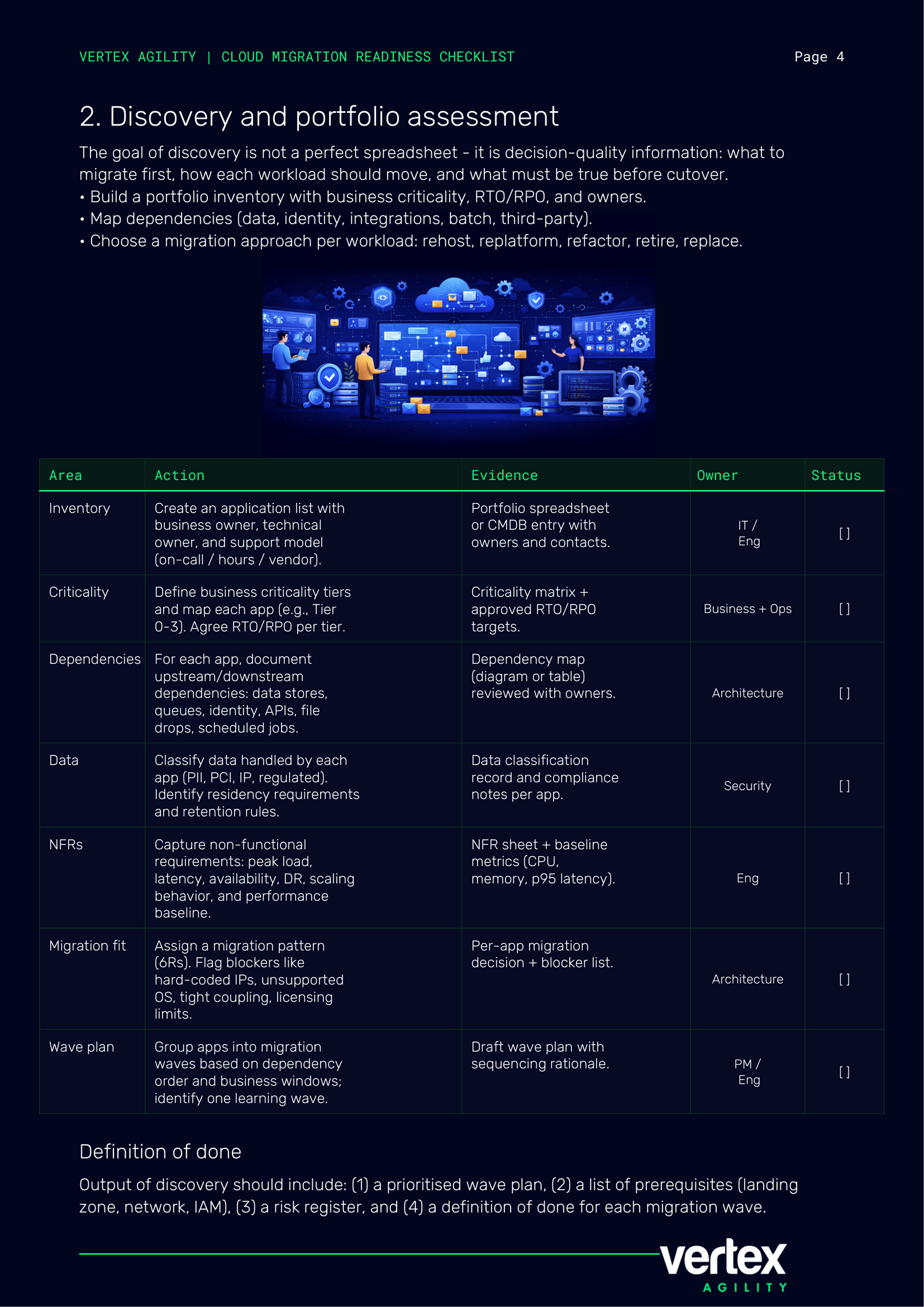
Example page (click to expand)
Download our free Cloud Migration Readiness Checklist now
Further Information - Technical Coverage
The checklist provides detailed guidance on the following topics:
Discovery and Portfolio Assessment: Mapping dependencies, defining business criticality, and selecting migration patterns (the 6Rs) for each workload.
Landing Zone and Governance: Establishing the foundation with account structures, Infrastructure as Code (IaC) standards, and policy-as-code guardrails.
Identity, Security, and Compliance: Designing identity as the control plane, data classification, encryption, and automated audit evidence capture.
Networking and Connectivity: Hybrid connectivity patterns, IP planning, DNS resolution, and egress control.
Data Migration: Strategy selection, schema compatibility assessment, and objective integrity validation.
Modernisation and Application Strategy: Externalising configuration, handling stateful components, and designing for failure with retries and circuit breakers.
Operations and Observability: Building automated CI/CD pipelines, instrumenting golden signals (latency, traffic, errors, saturation), and creating actionable alerting.
Testing and Cutover: Planning for load testing, rehearsal execution, and defining measurable rollback triggers.
Post-migration Optimisation: Establishing FinOps practices for cost visibility, right-sizing resources, and building a modernisation backlog.
Download our free Cloud Migration Readiness Checklist now

Our Partners


